


There has been so much chatter about Seedance.
That video with ‘Brad Pitt’ and ‘Tom Cruise’. The subsequent reveal it wasn’t made ‘magically’, but with real filming involved.
Plenty of “AI is coming for Hollywood” takes. Can I just say-
Its boring.
Every couple of months, a new 30sec video is meant to wow us. Then, more clips from AI Filmmakers are used to signal a creative apocalypse or creative utopia (choose your lane). I am not belittling the progress being made, (and definitely not including here the very valid ethical and copyright concerns which we *should* harp on as much as needed)…
…but really, I am now having to consciously tell platforms to stop serving me so much of the same breathless, hyperbolic, shallow commentary.
Ok, rant over.
But yes- this week has plenty of AI-related stuff bouncing around, like a ball chipping bricks in Arkanoid.
Same same: what happens when prompts give the same output?
▶️ Curated/Cuts: Claude gets cheeky, OpenAi wants to be meaningful.
What to watch?: Jiostar & OpenAI’s promise to make discoverability natural.
Buying Belief: AI services, influencer marketing & writing
First Person Goodness: the drone legacy of Milano Cortina
➕ OpenAI sued in Korea, Indian originals dip, the importance of news.
☝🏽Busy? Lazy? Multitasky? Click play above and let me read this to you, or here on Youtube.

1. Same same but how different?
With all the talk about how generative AI can dramatically open up creative vistas, comes the very real counterpoint- they can just as easily narrow creative possibilities. Across the creative and brand ecosystem, there are growing conversations whether creative standards, ambition and quality are moving in step with the pace of generative technology, or merely settling for it.
Somewhere Down Under, Springboards.ai is building “generative AI tools around a creative workflow to keep humans in the creative equation.”
In a recent project, they ran a creative experiment of sorts. It involved taking ‘inspiration’ from an existing ad to create a new one, asking “what happens when everyone feeds the same prompts into an LLM and ends up with the same ideas?”.
You might recall the ChatGPT spot from OpenAI late last year, one of a few that looked to plonked the LLM right into our normal lives. Here it is:
And now here’s the Springboards ‘rip-off’:
Ah, now you see what they were doing, yes?
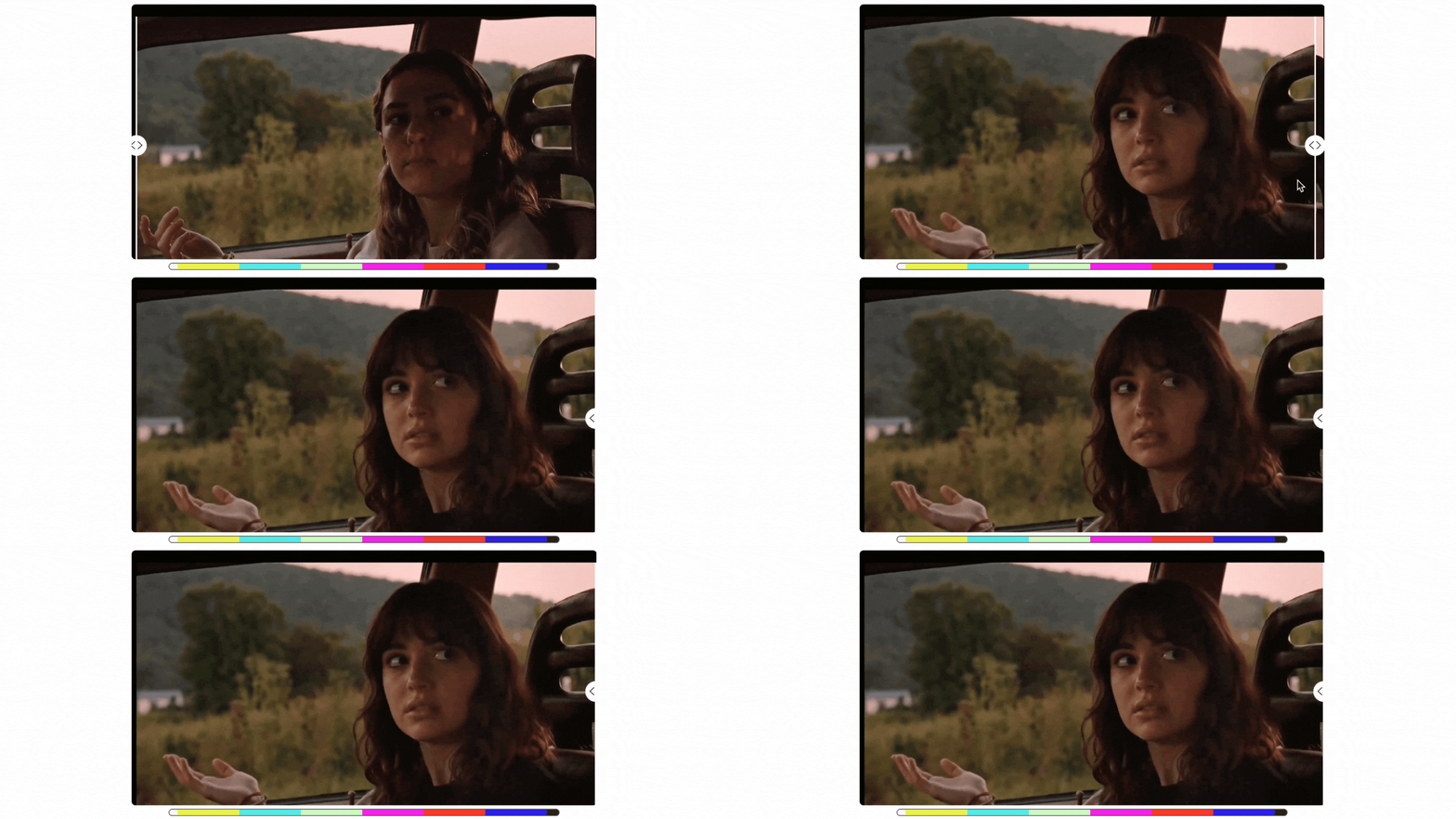
With a view to “showing how quickly these models can generate work that appears finished, but frequently crosses copyright lines and collapses into familiar patterns,” the group were led to three conclusions:
In the process of ‘creating’, it becomes tempting to stop exercising creative judgement altogether.
Research suggests LLM are starting to sound the same.
“Judgement gets blindsided”- easily replicated high production values can lead to originality and nuance being lost.
They’ve unpacked their thinking here.
While keeping in mind this comes from a company itself building generative tools, it’s a useful reminder- adoption without judgement is just acceleration. We really don’t want the creative cost (and creative loss) showing up later.

2. Curated/Cuts
Claude Picks a Fight
Another AI campaign that resists grandiosity, opting instead for mischief.
Anthropic’s Claude aired three spots around the Super Bowl circus. They chose to not talk about inspiration, intelligence or the future of humanity; instead, they homed in on a looming pain point from rival ChatGPT, making it their own virtue:
Ads.
The premise is simple enough. The spots are setI in therapy, while working out, at a casual founder pitch. These are focused, critical, even vulnerable moments.
And then an ad barges in?
Interrupt the wrong moment and you do not just annoy- you intrude, you betray.
"Ads are coming to AI. But not to Claude." This is bold. And clear.
Comparative advertising is a gamble. It can look insecure, or amplify the rival. But this calculated swing was enjoyable. It’s shorn of gloss, it’s funny, and it’s a pointed observation- do you want something so close to your life becoming ad-supported?
(It does assume the audience is paying attention to the industry. Many mainstream viewers will not know about ChatGPT’s product roadmaps, and ads are so intrinsic to our daily digital lives anyway. But the tech-leaning crowd will know, and they can be the tastemakers.)
As we saw in the recent AI Summit in India- where Altman and Dario couldn’t bring themselves to grasp hands on stage- the gloves are not fully on.
Claude is saying it’s the AI tool for our most personal, meaningful, even intimate moments. Let’s chuckle at the creative, but also pause to ponder that claim.
This continues, too, the wider theme in AI brand building- be human, warm, relatable, companionable.
All while selling industrial-scale infrastructure.
for Claude: Susan Payne · Director: Jeff Lowe ·
Production: Biscuit Filmworks · Ruper Reynolds Mclean · Music Sup: Sean Hogan ·
Starting With…
Talking of trying to be warm.
In the very 21st century tradition of representing both sides, let’s have a look at ChatGPT’s recent spots. They continue the tone and feel of that campaign from last year- real, everyday, relatable. In showing us where it can take us, they hope to be seen again as an invaluable, even fundamental, part of life.
Overall, the creative choices work- stay simple, eschew hype, be rooted, and with fluid execution.
There are two spots from India too, timed for the T20 World Cup (where Google Gemini is a partner). The connections are more tenuous, the believability not quite there, so these work less well for me- even though the music choices are very cool.

3. All couched-up and nothing to watch.
Shows, shows everywhere and not a title to pick.
The universal problem of plenty that unites couch potatoes* across the world- how to find what you don’t yet know you want to watch (and not find what you will know you don’t want to watch)? Friends? Word of mouth? How 2000s of you.
Ideally we all should just implicitly and wholeheartedly trust our streamer’s recommendation engines (not). But a boy can hope for other solutions.
For streamers and viewers alike, discovery is the real battleground.
Enter India’s JioHotstar (formerly hotstar/ Disney+/ Jiocinema). A recent announcement comes accompanied by euphoric choir music because it talks of a magical solution- their partnership with OpenAI to allow viewers to use “conversational language” to find what they can watch.
Voice/text interface. Multiple languages. Express intent or mood conversationally. Context-aware recommendations.
Sounds compelling. I would love to give it a go.
It will interpret cultural nuance, situational context and layered prompts. Sample this very quirkily niche example- “We are twins and only watch movies about identical twins,” (not quite sure how that made it into the release). But basically- ask and you shall receive. The same approach will in time extend to sports- think highlights, scores, player moments, turning points. That’s very promising indeed.
Beyond in-app experience, the collaboration will also see integrations within ChatGPT. Users looking for entertainment recommendations will receive “contextual suggestions and relevant streaming links from JioHotstar’s catalogue.”
That sounds more placement, less discovery. Will ChatGPT always give me a JioHotstar recommendation, ahead of competing titles from other platforms?
I’d love to see user feedback when this has properly launched.
*we don’t really say ‘couch potatoes’ much now, do we? Not because we aren’t potatoes anymore, (I am, on good days); but because we don’t watch only on the couch anymore? so…watch potatoes? Scroll potatoes? Binge potatoes?

4. Buying belief: humans wanted?
Influencer marketing is just regular life. Having creators in the marketer’s arsenal is standard. What many of us may not grasp though, as we doomscroll through laughs, opinions and how-tos, is the shape and scale of these collaborations.
Recent reports shine a light on how Big Tech has been deploying this machinery for its AI products. Content and posts, but also junkets, events, early access.
The intent? Transform attention to adoption. Impress. Amuse. Trigger FOMO.
There’s been some arm-waving, particularly around the amount of money being thrown behind these efforts- “Microsoft, Google, and OpenAI are paying influencers up to $600,000 to promote AI.”
This is not inherently sinister, and needn’t be misread for anything more than what it is- smart, expected marketing. Amplification.
And yet.
The scale makes people pause. AI is not a new sneaker drop or headphone. These are ‘tools’ being positioned as cognitive infrastructure. So when the messaging around them is pushed through glossy demos, frictionless life hacks, breathless ‘agentic’ workflows, it is worth keeping a healthy pinch of salt handy.
Relatedly, there has also been chatter about the increased role of Comms and ‘storytellers’ in these organisations (an example- Anthropic tripled its team to 80, and is still hiring). A BI article tells us the hottest job in tech is “writing words”. They’re looking for narrative control, as “the rise of slopaganda is fuelling a surprising tech hiring boom”.
Many see a distinct irony in how the companies offering tools to automate writing and creating, are valuing those very skills so highly… in humans.
Generating words and writing them, it would appear, are not quite the same thing.

5. First Person Goodness
The Winter Olympics Milano Cortina just wrapped. I can’t say winter sports are staple watching in our home, and I’ll be honest- my skiing skills, though brilliant, are limited to 90s video games. But the Olympics come with their own appeal, so some viewing happened here in our sunny climes.
And when we watched, one thing stood out big time (for clarity, I don’t mean the royal ‘we’, but me and the family).
The incredible POV drone footage. It really swooped us into the action, the hillsides, the tracks. Yes, drones are not new to sport anymore- but there was something about these FPV drones, in those settings, that really raised my viewing experience. Sports coverage is prone to the odd gimmick, but this here is no mere novelty. These cameras, these angles, this dynamism (and these skilled operators) are here to stay.

As you might imagine, flying these drones in such dynamic settings can be a challenge. Custom builds. Lack of pilots. Radio frequencies. Weight.
Hop over here for a brief peek into how much of a challenge it can be, with OBS CTO Sotiris Salamouris talking about Milano Cortina’s ‘drone legacy’.
➕ Quick Hits
TV networks in Korea have sued OpenAI for using their content for training, saying, “OpenAI has refused any negotiations with the three broadcasters and continues to maintain discriminatory copyright policies.”
The volume of Indian streaming originals is at its lowest since 2020, according to an Ormax report. After peaking in 2023, the category has witnessed drops of 18% and 13% in last two years. The merger of Disney+, Hotstar and JioCinema into one app has been the biggest ‘villain’ here, with the inevitable rationalising in their collective offering.
While many of us would readily accept the value of news, not as many might ascribe real importance to following it in a responsible, meaningful way. A recent Pew report showcases this tension in the US, one I feel will be a common tension in many regions. Half say they are worn out by the amount of news, two-thirds have stopped getting news from a specific source.

If you enjoy reading The Colour Bar, maybe get me a coffee ☕ and help fuel the next one? And please support by sharing pieces you like, or forwarding to others who might enjoy it.