


☝🏽Busy? Lazy? Multitasky? Click play above and let me read this to you.
I flit around a few brand promises this week- a crafted history of Suede from Puma, Under Armour’s chaotic hotel, The Economists’s take on AI, and Bose properly entering the content scene.
But first there is an epic-looking production from a Dutch animator that harks to skeletons, Stalin and resurrection. It seems like a staggering effort, and as with so much in our time, there are little voices questioning it too.
Hi again- thanks for letting The Colour Bar into your feed, or you inbox, or both. If you have not already, please subscribe for these weekly dispatches here , or get The Colour Bar in your inbox.
Cheers,
Shakey
A Macabre Dance: A short film 11 years in the making.
Bose: Another brand with content ambitions. Legit?
Curated/Cuts: Puma x A$AP Rocky, Under Armour, The Economist.
➕ · Peacock x Youtube · The Hundred · Music Influencers · Iceland Air ·

1. Danse Macabre
A recent animated short film saw the coming together of 75 oil paintings, over 30 artists, and 4 countries.
Knowing that and watching the trailer might well make you pause, to consider and admire the craft behind Danse Macabre. For some, it also coughed up questions around AI.
“Every day I was listening to the music, coming up with images that were inspired by the music, and then developing my ideas for the film.”
Hisko Hulsing has been working on this for around 11 years, and it all started with music and was utterly born from it- specifically, Russian composer Dmitri Shostakovich’s Tenth Symphony.
His vision- at least in the trailer- is quite something to behold. A sense of the epic combines with dramatic scale and action. It is a film about chaos, death and fascism, as the symbolism immediately shouts; a march toward light that descends into chaos, the maker says.
“I didn’t have a script. The storyboard was the script.”
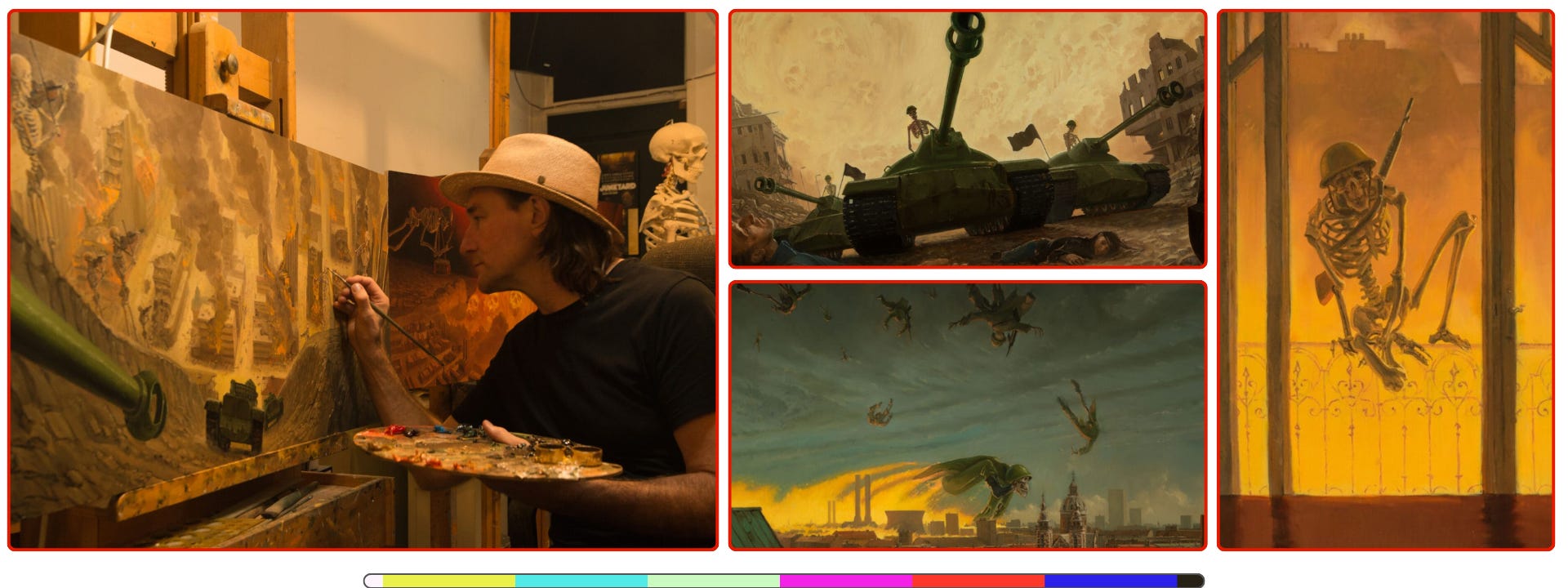
Long before the main production- years before, in fact- Hulsing was creating these large oil paintings that would form the striking world of Danse Macabre, eventually serving as backgrounds in the film. It was clearly a “tremendous undertaking required before other artists and animators ever got their hands on it.”
There has been some curiosity/chatter/displeasure that there is some level of AI used. Hulsing himself refers to it in the BTS, using the term Machine Learning, describing how they trained Stable Diffusion with hundreds of his own paintings. He even dove into that reddit forum to share his production flow.
About a year ago, he spoke with Asifa’s Stefan Stratil about his journey from animator to director for the likes of Netflix & Disney. They too touched upon his (then ongoing) production of ‘Resurrection’, which would later be renamed Danse Macabre.
Six years ago, we used projection mapping to make the 3D skeletons look like they were painted. But now we’re using Stable Diffusion, an AI program to stylize the skeletons. We fed Stable Diffusion with all my paintings to train it. The animation is completely done by animators using Blender, the 3D animation software. Then we use all the information from the 3D animation, the crypto map, the depth map, the line-renders to control Stable Diffusion to make it look like it’s painted by me.
Stefan : Well, you could let the AI do the last 20 paintings.
No way. No. And that’s the thing, you can generate paintings, but what I have seen looks horrible. We only use it to make the 3D animation look like I painted it. But the background is a different, a really different story.
Essentially, AI tool Stable Diffusion was used, but trained entirely on his own paintings. (There is something to dig into, that the tool’s underlying abilities are still trained via questionable methods.)
The doubt (and subsequent reactions) about potential use of AI in this short are representative of how the creative community (and fans) are developing sceptical eyes - for everything. Yes, it could be said that laypeople and ‘consumers’ won’t care (as much)... but methinks that’s a right proper argument, not a given.
The thing is- such ‘workflow’ use starts to fall in a grey area, and in an age of black and whites, polarising views, choosing sides, the greys tend to suffer. Because they need the most effort to understand and grapple with.
Either way, that’s still a short I’d like to watch.

2. Bose: another brand does content
Bose announced the launch of Bose Studios, a content initiative. An early big ticket announcement is an original documentary series being developed with filmmaker Steven Soderbergh.
Brands entering content has, of course, become more common, it almost feels like there is some FOMO attached to it. But there being a genuine fit is much less common- and their success is wildly variable. This one though, feels about right on the face of it- its easy to argue that Bose has more of a ‘right’ to create entertainment and become part of “the rituals” we all have around music.
Bose has been giving content a go- I recall Turn The Dial, based on the sound premise of increasing the number of producers of all genders—not just men; which for some reason seems to have been very short-lived. But here we have a more coherent and ambitious proposition.
They have made the right noises- “”This isn’t product placement; this isn’t a long, 30-minute commercial,” the CMO has said.
They also announced a record label, to enable lesser known or ‘underappreciated’ artists to be discovered. A music label from a brand brings some narrowed eyes, questioning both intent and likelihood of success. Bose doesn’t want to own the music though, and they do transparently say that this will give them license-free music for marketing.
As with much in branded content, announcements like these come with some scepticism. But hey - we live in a time when a shoe company rebooted (pun intended) to become an AI company, so there’s that.
Talking of- Marriot Bonvoy recently sponsored content out of Coachella; ‘Arrival’ incudes a short follow-doc on girl group Katseye and their first performance at the festival. Fairly subtle brand integration, in their effort to “infuse its ethos of creating lasting memories.”

3. Curated/Cuts
· Suede Forever ·
Firstly, I only just learned that A$AP Rocky has been Puma’s ‘Creative Director’ for about three years now. I stumbled on this after watching this time-scrubbing homage.
It’s a nice little journey of the Puma ‘94 Suede in history, from 1948 through to the 90s. It feels authentic , lived, brought to life without too much unnecessary drama, with multiple visual and craft aesthetics thrown in for the eras.
The line “some people wear brands, some people become ‘em” stuck with me. It works for A$AP Rocky, but for us commoners it might feel like ‘I become the brand I wear’, which is… less appealing?
Cute ending, too!
· Chaos at Hotel Armoure ·
Under Armour figured ‘Rest Less’ should be the theme of the summer, conjuring an imaginary hotel where football stars (and others) show up and usher in chaos for everyone else. With incredible timing, Ferran Torres stars- he of World Cup final goal scorer fame- chilling in a pool of ice.
If anything, it feels a tad rushed, though their socials do give a slightly better glimpse into these VIPs : Ferran Torres , Ollie Watkins, Riles
White Lotus in 30sec, much?
Agency Mox
· An Economist 2-for-1 ·
Came for a counter-AI campaign by The Economist, stayed for their curious rebrand.
Their recent campaign builds their take on ‘cognitive surrender’, questioning how AI might affect the way we think, and “the growing tendency for people to accept AI-generated answers without applying their own critical thinking.”
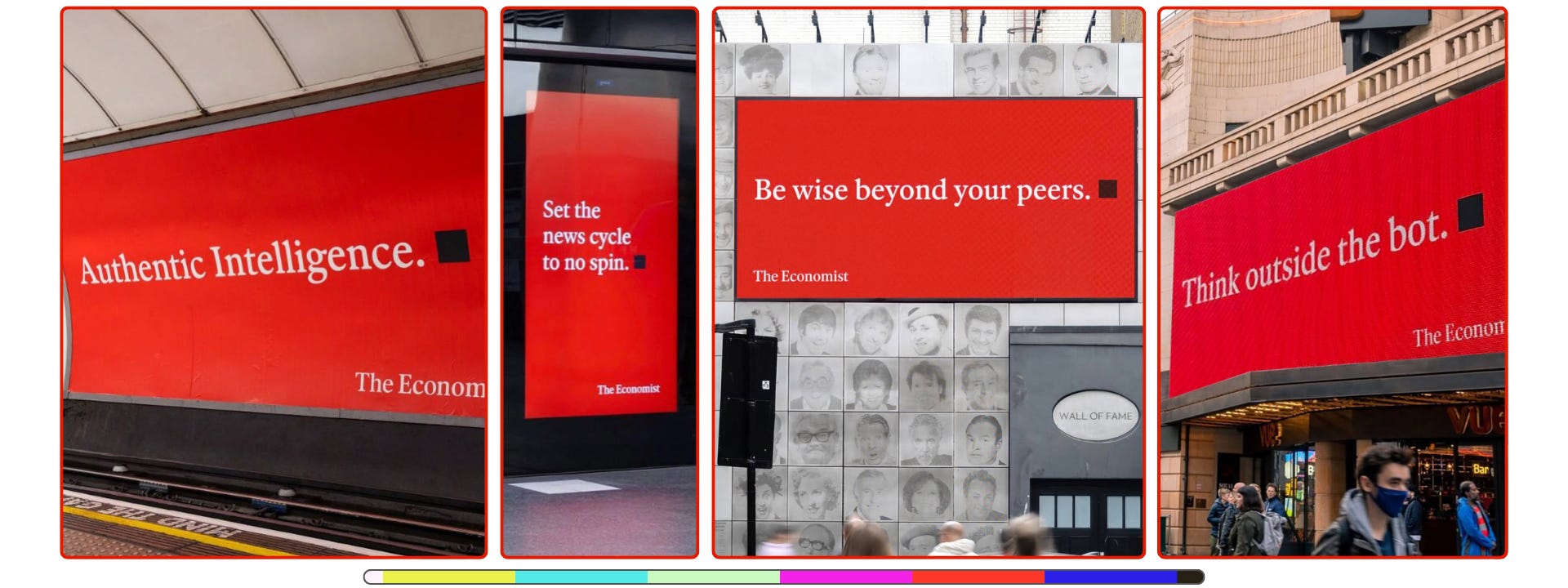
The Drum mentions an interesting backstory. “It began as a series of speculative ads created by one Ant”; the Economist then commissioned Ant and his agency Cocogun.
In case you’re wondering what the black square is (someone said ‘dead pixel’!), Yafet Bisrat was kind enough to point us in the right direction- it lies at the heart of a 2025 rebrand done by Nomad. “The ufinish ends every article. Now it punctuates marketing headlines, frames key ideas and guides audiences across every marketing touchpoint.”
How does that work for you?

3. take: Peacock on YouTube
Peacock and Youtube announced a partnership in the US, whereby the streaming service will be available as a bundle with Youtube Premium in 2027. Such bundles are not uncommon in recent years as streamers in particular look for any avenue to boost subs. This one is a bit more interesting, and you can count on Doug Shapiro to tell us why (highlight mine).
…it seems unlikely YouTube is paying Peacock anywhere near its retail economics—probably no more than $2-3 wholesale. Peacock currently generates about $8 in subscription fees and $5 in ad revenue monthly. Why would it incur the cannibalization risk to sub fees? It’s a bet on advertising (and lower marketing costs and churn) making up the difference.
With the AI-powered content deluge upon us, with the likelihood that “content goes from profit center to cost center,” he feels the burden will fall on advertising to make the economics work.
It’s an idea he wrote more on here on The Mediator.
➕Quick Hits
Tom Novak talks of a “shift from algorithmic curation to commercially engineered culture”, as he shares an NPR piece about music influencers who are paid to talk about songs, often without disclosing the deal.
Bursts of colour, and a happy fresh feel for this year’s titles for The Hundred.
Remember when Iceland Air was looking for a really bad photographer?
Well, they finally found their hallowed choice last month, and young Blanche has just completed her road trip around Iceland. Her masterpieces will be revealed soon.