


Why are we conditioned to treat women’s periods like a taboo topic? Norms across cultures- historic, traditional or modern- all shy away from it. I’ve seen sanitary pads hidden in black plastic bags at shops, heard the words spoken in hushed tones, known places and people which partition themselves from menstruating women.
I find it all absurd. So when I see a brand like Kotex embracing period blood, I am so here for it!
I’m also down for some digital nostalgia courtesy Pinterest, plus I weigh in on the AI voice artist landscape and another micro drama player.
Come join me in this bloody, non-violent edition.
There Will Be Blood: Art’s Missing Period.
▶️ Curated/Cut: How did they live before social media?
VO Wars: My voice, your voice, no voice.
Tadka: India’s new (big) micro drama offering.
➕ · Nipple sponsorship · Clipping economy? · Kill YT Shorts· ·
☝🏽Busy? Lazy? Multitasky? Click play above and let me read this to you.

1. There Will Be Blood
Brand x Art x Relevance.
A rare fit.
Most of us have heard something about art making us uncomfortable, and how that is a specific role it can/should/must play. Many are happy for art of any kind to be pleasing, satisfying, and yes- comforting. But that is that beauty of art- it is infinite and there is room for every kind. Whatever you might consider the role of creative endeavour, what is distinctly clear, is that art is an expression. Be it from an individual, a team, a collective. Be it a statement, a question, a wish, a memory, a speculation.
Most of us have been born into worlds which value that expression. I won’t be naive- freedom of expression is demonstrably hard to agree on, across cultures. It collides with norms and clashes with beliefs. And, it is constrained by systems, crushed by power. Yet its core value remains largely embraced.
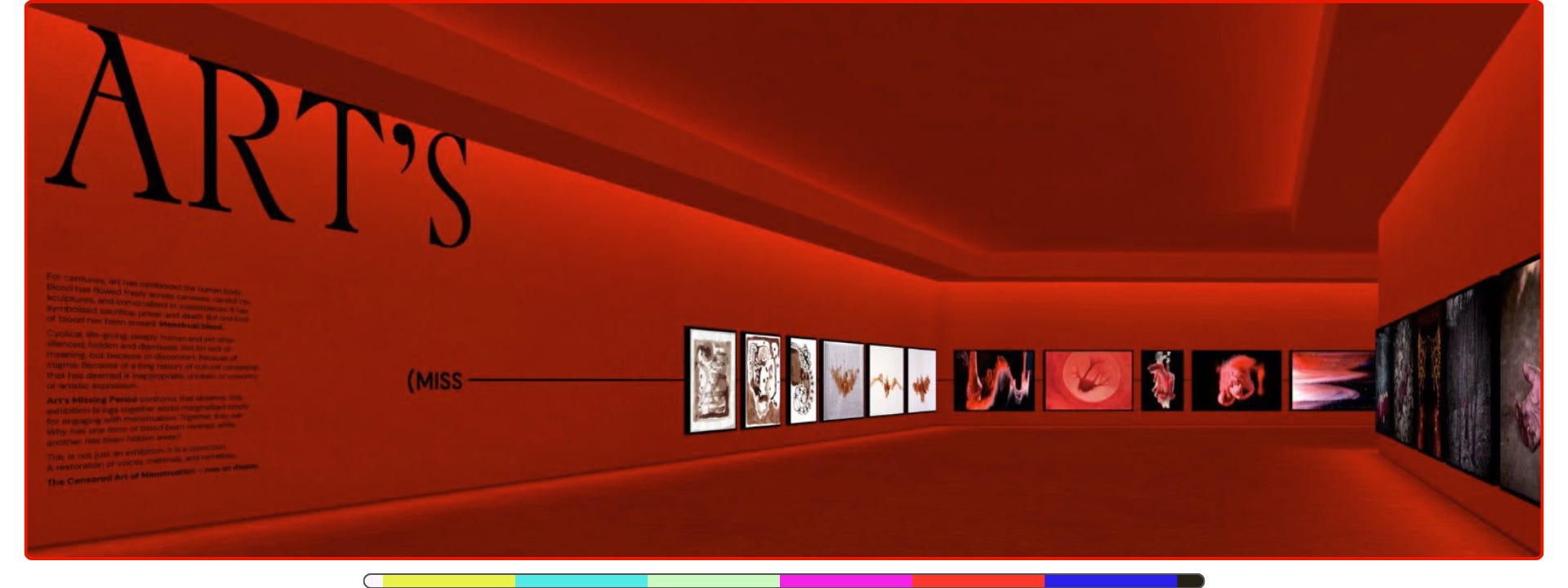
This little trot into art philosophy is spurred by a short documentary. Art’s Missing Period is an 8 minute piece exploring the systematic deletion of women’s menstrual cycles from art across the ages. Here’s the trailer:
It begins with the striking observation that blood has flourished across art forms, across time. The violence or tragedy it depicts is not found inappropriate, nor too sensitive. The blood flows freely, so to speak- except period blood.
This film (Youtube link to full video) is part of an effort to ‘uncensor’ the art around menstruation. It is brilliantly coupled with a virtual exhibition that can help find some answers, and raise more questions. Art featured goes back as far as a few thousand years BCE, with pieces from our times that have been rejected or censored by galleries and other custodians of morality.
“Why is some blood revered in art, while menstrual blood is silenced? The exhibition confronts the stigma, showcasing menstrual-themed art from around the world.”
And so to the who.
This is part of a campaign devised by Kotex, with agencies David in London and Ogilvy in Singapore. Given how relevant this is, it almost seems immaterial who is behind it- which is part of the brilliance of Kotex choosing this path. The fit is obvious, the choice anything but.
It is very, very hard to combine layers of meaning and product and brand, yet create something of substance, without feeling opportunistic or shallow. I think Kotex nails it meaningfully here. Kudos.
The question I have- to connect and challenge the thought in my opening line- why do we even feel uncomfortable about this? I am all for art ‘disturbing the comfortable’, but menstruation is the most natural of biological occurrences. To analogously hand it a popular modern phrasing- it is a feature, not a bug. A pity then that we have over the ages been conditioned to recoil at its mere mention, to make it taboo.
My only gripe? The short film left me feeling like we skimmed the surface- even at over 8min, it feels like a trailer for a full thing. I suppose in some ways, that’s a good sign.
Kotex CCO Luiz Sanches · CD Denis Kakazu · Head of Creative Gustavo Sarkis · Marketing Katie Nikolaus ·
DAVID ECDs Selma Ahmed & Genevieve Gransden ·
Production Object & Animal · Director Kathryn Everett · EP Dom Thomas ·
Noor Tagouri, Journalist

2. VO Wars
It will come as no surprise to most reading this that AI is being used heavily in localisation & versioning of film & TV around the world- captioning, translations, dubbing, ‘vubbing’. Some of the output from the SaaS voice services can be truly impressive, though not all of them have their provenance sorted.
At one end you have Matthew McConaughey & Michael Caine who have licensed their voice likenesses, available in the Eleven Labs marketplace; at the other you have Scarlett Johansson and Tom Hanks who have explicitly refused to do so. But there is a vast majority who lie between these high profile extremes. And they are struggling to come to terms with how rapidly this is moving- especially in markets outside of Hollywood.
Unsurprisingly and inevitably this impact is often left by the wayside in much commentary. But many territories do not have robust systems in place (unions, rights, etc), if at all. Rina Chandran in Rest Of World has a piece with some real perspectives from countries like Brazil & India. “AI is increasingly used to deliver content cheaply and quickly, and voice actors are beginning to push back, even though they don’t have strong unions.” With touch points around the world, we get a glimpse of the fights voice actors are waging to salvage their livelihoods.
My take- voice often seems the easy one, the early fall guy. The tech has moved fast, and there is a general perception of “it’s just a voice”. But there is more to this than hand-wringing over lost jobs. Central though that must remain to such conversations, we mustn’t lose sight of the impact on local cultures. There is an intangible value to the nuance, storytelling and flavour imparted by the person behind a voice. To any story or narration, they bring their own perspectives, ability, creativity and- maybe most importantly- their lived experience.
If we shrug at those in the name of efficiency, we do so at our own peril.

3. Curated/Cut
· How Did They Do It? ·
Life before social media- what’s that?
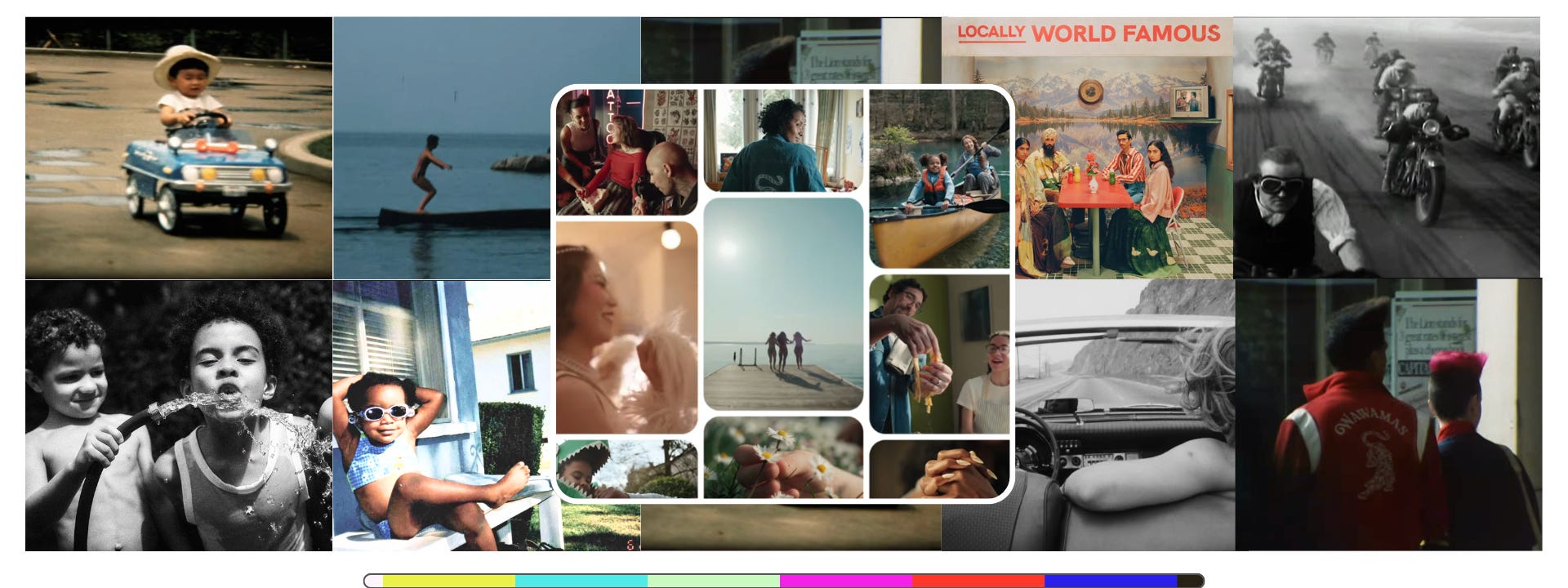
Pinterest continues its efforts to be apart from other social media. Last year, their campaign encouraged ‘unfollowing’, assuring us we could find our own unique take. With a little help from Pinterest, of course.
Their latest is a warmly crafted theme film that suggests the best thing we can do online is find a reason to go offline. The brand leans into the palpably growing sense of overly-plugged in lives, coupled with an affection for the before times. What we have is a rose-tinted look at how life before social media was less influenced, less validated, more our own.
I say rose-tinted, but I do mostly mean accurate. The struggle to touch grass is real.
Almost as enjoyably, their ECD Becca Morton has a bit of a back story here, which will show you how it is just so bloody easy to come up with excellent creative stuff.
Not.
Pinterest Global Creative Xanthe Wells · ECD Becca Morton · Writer Gage Clegg · Global Mktg Sara Pollack · CMO Claudine Cheever ·

4. Micros come to JioHotstar
The micro drama (nay, micro shorts; nay micro shows, series, micro something) electric train whizzes on. The latest significant player, this time in India, comes in the form of Reliance behemoth Jiostar. Named ‘Tadka’ for the little concoction of flavour or spices splashed on in most Indian cooking, the service launches within the ‘main’ streaming JioHostar app.
Its campaign boils down to “my shorts are better than yours.” An active diss to other social feeds- don’t waste your time on reels, it says, get on to Tadka.
We could debate the virtue of addictive micro dramas vs addictive random reels into the wee hours (ok, I could but I probably wouldn’t… but you get what I mean). But that ship has sunk sailed.
The nuts & bolts are familiar now. ~2min episodes, 20-50 episode runs, 100 shows at launch.

The Tadka rollout, conversational discovery tools and the scale of content investment suggest JioHotstar is not treating micro-content as a side experiment. It is positioning it as part of a larger play to widen engagement, hold on to users longer and build new monetisation layers inside its streaming ecosystem. ^
If there’s been a gold rush into the micro drama space (even if many still question where the gold is), there is also an inescapable feeling something will eventually give. The entry of established streamers/legacy players is the most obvious harbinger. As I noted in a roundup last year, the big boys are widely seen as the ones to dominate. We have known for some time now- and as we have seen in other markets in US and Asia (ex China)- once you get past the logistical ease and low production demands, it is the discoverability + marketing spend in acquiring viewers that proves to be a challenge.
Tadka is bundled into the overall JioHotstar offering; Fatafat (Amazon’s shot at the space on their MX Player) is entirely ad-supported. Such players most likely see this as a funnel for wider discoverability of content, customer acquisition and ad/brand plays.
While we wait to figure this out, you could always go check out what’s happening with the Security Guard & his CEO Girlfriend.

➕ Quick Hits
The Nipple sponsorship- Vaseline has been named the ‘Official Nipple Protector’ of the 2026 TCS London Marathon, to keep runners ‘safe from the chafe’. Clever.
I‘ve written about the deluge of clips of shows or podcasts that flood our social feeds. I had looked at how the business of ‘clipping’ is fast becoming a lucrative one, i.e. those who do the actual job of making clips (yeah, ‘editors’). Ed Elson over at ProfG M has a rather more gung-ho view on clipping as a revenue source for creators, suggesting everyone (especially legacy media) needs to get on the train. “Clips are no longer the byproduct of the main product — they’re the main product.”
If you’re not a fan of how Youtube keeps propping up its shorts while you use it for ‘proper’ videos- well, you can now turn off Shorts on YT entirely. Its more a hack really- limiting the time for shorts- but I guess we’ll take it? Now- someone tell me how I can switch off videos on Spotify!
“Art should comfort the disturbed and disturb the comfortable.”
So said Mexican poet and educator Cesar A. Cruz,
though the line is often attributed to Banksy, who popularised it in
the early parts of this century while describing his activist art.