


Welcome to another collision of creativity, brands and tech. I write The Colour Bar every week and you can get it here on Linkedin (subscribe up above, and follow me), or you could subscribe over on Substack too if that’s your thing. And share what you like please!
This week’s swirl includes a meme from Devil Wears Prada, Rolex meeting puke, AI & music’s ongoing tussle, very odd phone love, and more on everyone in media’s second-favourite ride, the micro-drama train. Hop on!
Thanks,
Shakey
Artists, Memes, AI: crafted cheapness, sensing Aesop, vomiting Rolex.
Verify The Humans: Spotify, Deezer, AI music & fraud.
Curated/Cuts: Phones Love, Transport Love
The Micro Train: Some micro breakdowns
➕ · disappearing trends · AI chat groups · ElevenMusic ·
☝🏽 Busy? Lazy? Multitasky? Click play above to hear me read this to you.

1. Artists, cheap memes & AI.
· Want Some Lies With That? ·
The Devil Wears Prada 2, aka DWP2 brought the 2006 hit back to cinemas and is doing plenty well. The marketing and social around it too, has been hard to miss- it felt like it was everywhere.
Yet, after the movie’s release, one of the little things that made waves (or some ripples) was in fact a 2-minute snip from the film. It comes from a bit where memes are being made disparaging Miranda, the character played by Meryl Streep. This one meme, appearing amongst a few, felt to many as a hat-tip to AI slop.
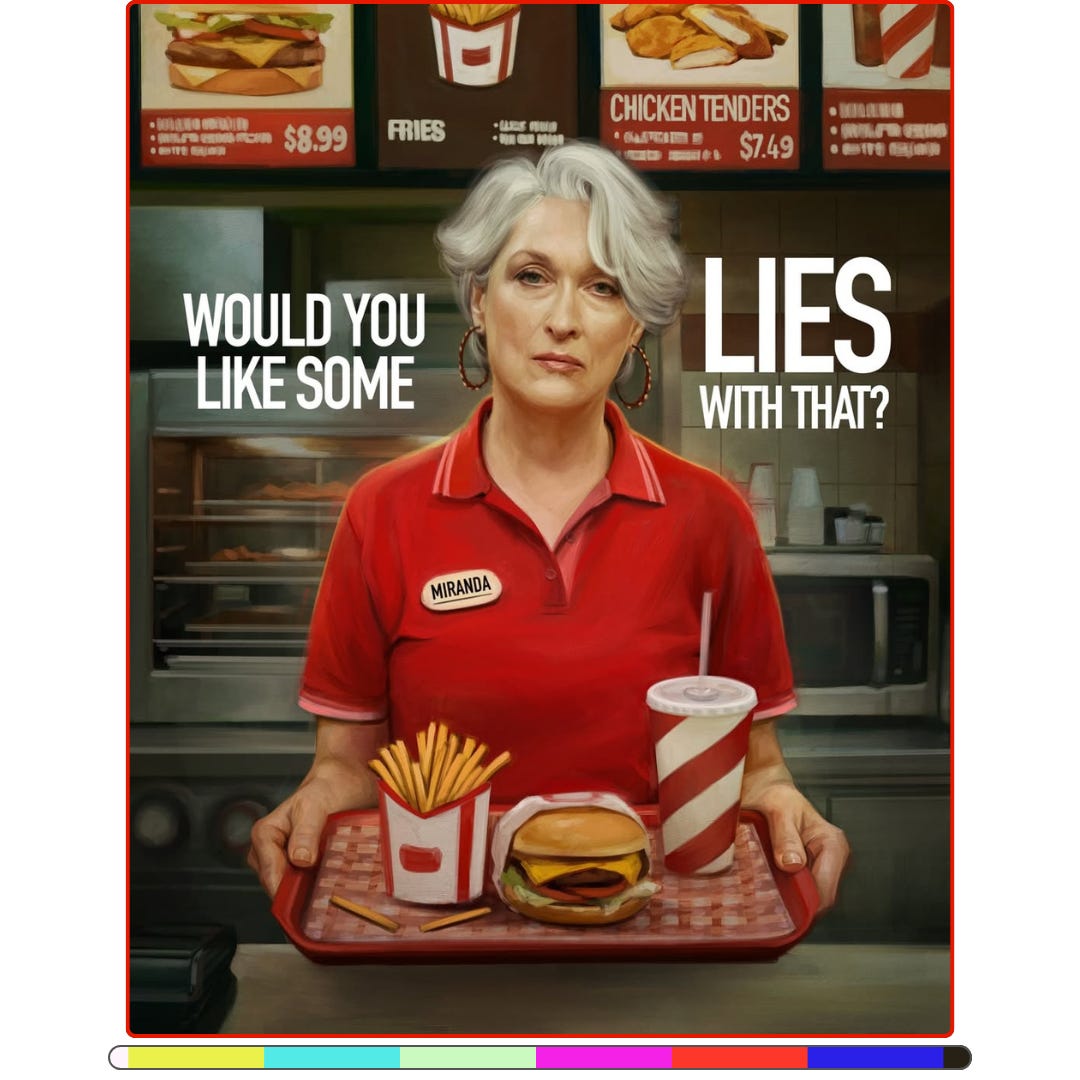
In fact, as artist Alexis Franklin shared on her socials, this was made by her and her alone. Additionally, she said that mimicking AI was not really the intent.
“I was not attempting to mimic AI when I painted this. AI studied what we do, of course there are similarities. I was just trying to make a cheap meme, guys. The theories are wrong. 🥲
Absolutely no disrespect to Queen Meryl, but this is something I would’ve painted in my free time, so when they asked me to do this it was nothing but fun. 😈”
Elsewhere, she said she was going for a “cheap, plastic look that reminded me of the photoshopped 2010’s meme aesthetic.”
This is a fine example of how our times will see us all both readily believe AI-fakes, and jump on accusing human creation of being AI generated.
Both sides, at once, confusingly and inevitably.
· Sensing Aesop ·
Synaesthesia is a neurological phenomenon where the stimulation of one sense involuntarily triggers experiences in a second, unrelated sense. Some refer to it as ‘sensory crossovers’- think tasting colors or feeling sounds. People describe it as having “wires crossed” in their brain because it activates two or more senses, when there’s only a reason for one sense to activate. It is not a disease- more a consistent, lifelong sensory blending.
This rare phenomenon has given Irish artist Jack Coulter the ability to perceive sounds and smells as colour. In a sense, he can translate music or scent into pigment.
“If I hear sounds they’re all connected together, that’s when I see very prominent colours. Depicting scent is a very different process.”
Aesop, the Australian cosmetics brand teamed up with Coulter some time ago. Instantly, you might think- that is such an obvious collaboration/ commission! And so it does, in hindsight.
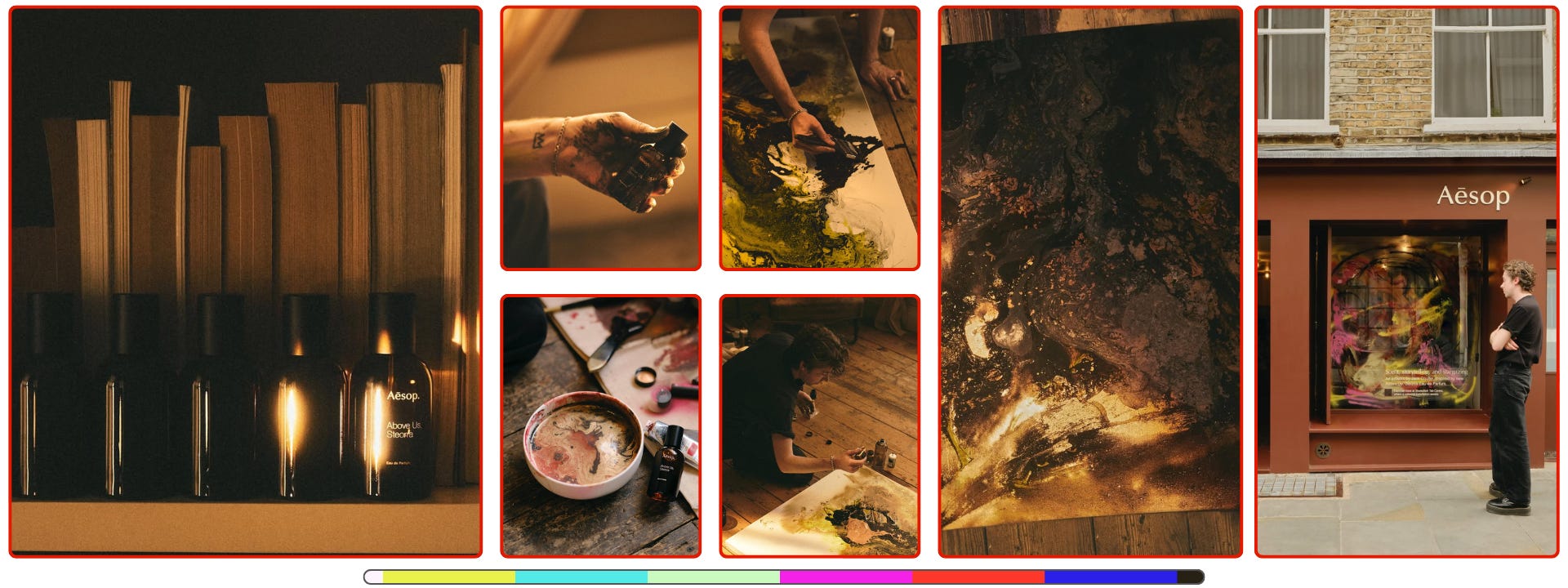
Aesop presented the work as hues of their perfume Above Us, Steorra Eau de Parfum. “For synaesthete artist Jack Coulter, the aromatic is experienced as colour. His latest piece draws inspiration from Above Us, Steorra Eau de Parfum, offering an abstract take on the fragrance’s compelling constellation of notes.”
A fascinating collaboration.
· Vomiting Rolex ·
Spanish art collective milfshakes (yes, thats…. milfshakes, let’s run with it) recently did a one piece giveaway for a Rolex.
Oh, but this was no ordinary Rolex. The dial was uniquely art-ified. It was detached from the watch, put in a ‘controlled chamber’ where- wait for it- housefiles were sent on a vacation. They were fed plant-based coloured dyes. Now- flies digest by releasing digestive fluids (or something like that).
You guessed it, they puked all over the dial. Make no mistake, this was unique.
The project was titled “Time Flies,” and used a Rolex Oyster Perpetual. The collective called it a ‘biological art project’, artistically customised by flies, clarifying that Rolex was by no means involved.
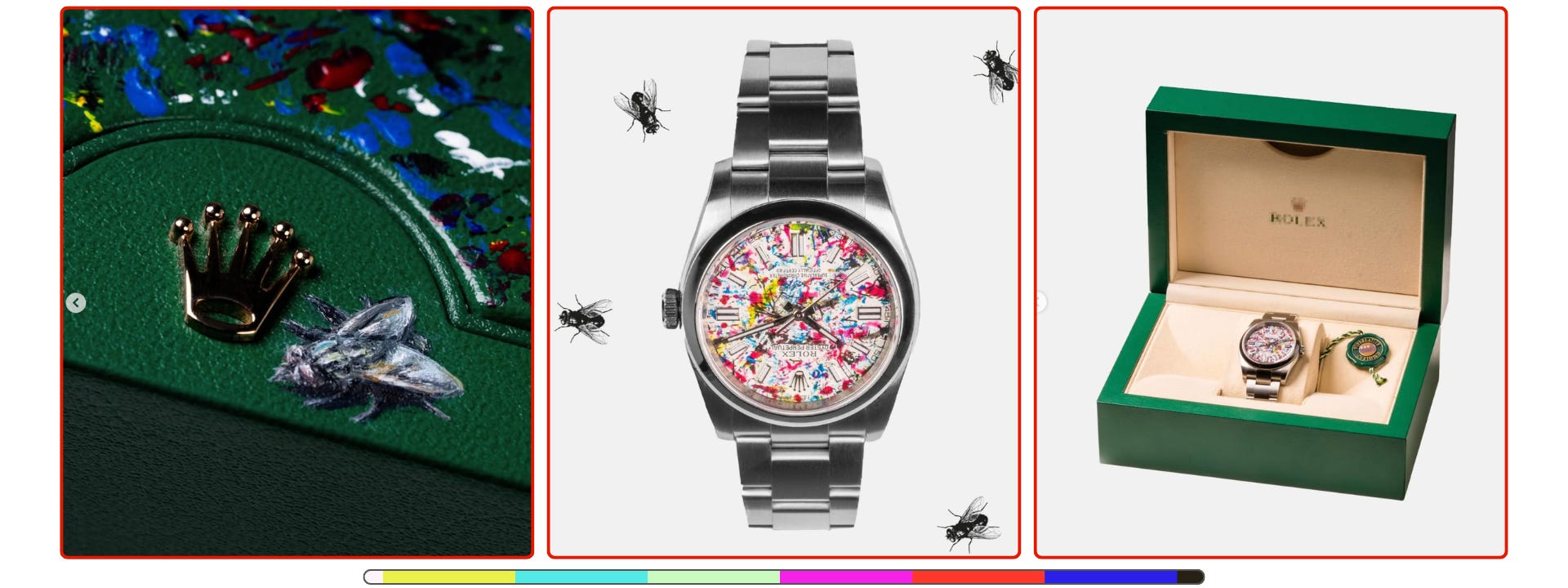
BTS here, if you are curious.

2. Verify The Humans!
I am repeatedly drawn to movements in the AI-generated music space and all its ramifications. This week, Spotify has announced ‘artist verification’, largely in an effort to improve authenticity and credibility on the platform.
This is welcome.
It is not everything, but nothing can be, in the very messy space of AI-generated / assisted music. So this is welcome.
Spotify is more often than not in the crosshairs for much, but definitely including AI generated tracks, which I have spoken much about. Deezer has been far more proactive and decisive in their ambition of filtering out AI generated music and artists. It has filtered millions of AI-generated tracks being uploaded, ensured AI tracks are out of their playlists and algorithm, all with developing their own detection tool.
My 2025 year lookback on the space- Music & The Machines- was full of aha moments and things that make you go hmmmm.
Spotify has taken a slower, wait & watch approach, citing the complexities around it all, and largely letting the onus be on the artist /uploader to opt-in their AI use.
With ‘Verified by Spotify’, we are promised “a clearer signal on artist profiles”, with the badge meant to be a symbol of “an artist profile (that) has been reviewed and meets Spotify’s criteria for authenticity and trust.”
Note, this is not by any means a stand against AI-generated music, nor a clear statement of intent to weed it out. Its another small step, though a potentially better one than any before, to make progress. Indeed, a verified artist uploading a 100% AI-generated track seems perfectly clear for now.

Fake streams, already a source of siphoning away streaming revenues, have been powered by AI. The volume that gen-AI services help provide, are a way around fake streaming that has been identified by high numbers of streams. In a recent piece entitled “How AI-Generated Music Became A $4 Billion Fraud Machine”, Virginie Berger runs through the landscape really well.
Fraudsters now use AI generators to flood platforms with millions of tracks and stream each one just a few thousand times, enough to generate royalties from each but not enough to trigger detection systems tuned for high-volume replay.
She also talks about the services allowing users to strip away AI artifacts, saying “The detection and evasion layers are scaling in parallel.”
Her take on Spotify’s verification move is less than enthusiastic. “The badge authenticates the artist, not the music. A verified human artist can still upload fully AI-generated tracks under their verified name. Spotify is drawing a line around identity while taking no position on content.”
An aside- badges, badges everywhere- with varying parameters for varying uses, on varying services, paid and unpaid. How soon before we are all confused across platforms and those pesky ticks are rendered wallpaper?

“Go take the darkness out my heart” he drawls,
just as limbs around him move in a coordinated storm of anger and togetherness and aggression and disregard and brotherhood.
I wonder if the point was madness, anarchy, unity… or something else entirely.
This is from my recent piece on Coffee & Conversations, where I found myself captivated by a darkly compelling music video. Have a read?

3. Curated/Cuts
· Phone Love ·
Here’s an off-kilter one this week. It comes from Blink’s Youtube series ‘im glad i know that now thank you’, created by artist and writer Chris with director Mike Greaney. This one is on phones, and how much we love them.
You might chuckle, guffaw, gag or shrug your shoulders- but I don’t need to introduce it more. And you needn’t think too much more. Just watch.
· UK Transport Love ·
“Sometimes it’s about how you say it”. With this little copy, UK’s Department of Transport shared a bunch of clever, amusing images on social.
“Transport is a universal language, that’s why we’re working hard to make sure your journeys are simple and reliable, wherever you are and wherever you’re going.“
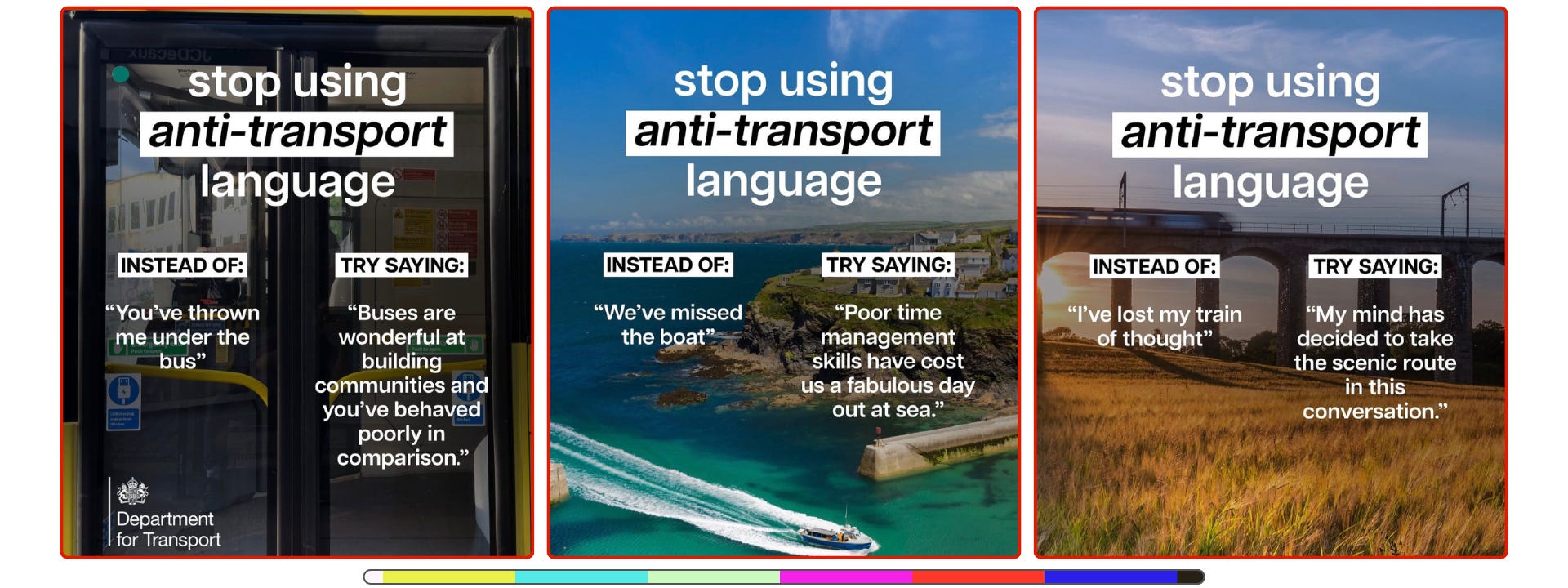
It amused many, but riled up enough disgruntled London commuters too. Ah well, the nature of the social beast.
Also, likely a riff off the PETA stuff from many years ago.

4. The Micro Train
The micro-dramas juggernaut, we are told every week, continues its march. The format has become an undeniable force with its sheer eyeball numbers. The structural aspects seem less clear or water-tight. Too many of us view the micro-drama space with a hint of scepticism based around the high cost of acquiring viewers. Marketing spends are the real key to making this work. Production costs are increasingly becoming secondary, not really a meaningful differentiator.
I always felt that the big players will inevitably own or control or dominate the funnels. This does run counter to some of the hype around the micro-drama space in general I feel, without taking away from the momentum the format itself clearly has.
These aspects and much are explored by Patrik Wilkens in this excellent breakdown that links micro-drama, AVOD, Platforms (Tiktok & Meta particularly), with production perspectives.
For producers, it is starting to be that production costs are not the central issue- the revenue model with the platform/ ad-sharing/ subscriptions is where the choice lies between being a supplier or participant.
I am reminded of this quote from last year’s APOS which I shared in one of my previous micro-drama explorations. Zhou Yuan, Founder & CEO of Content Republic, had put it plainly, “I don’t believe there will be a Netflix of micro dramas. It will be the three big guys—Meta, YouTube, and TikTok. We will be vertical production studios.”
Indeed.
The real cost is not in production or storytelling, it is in discoverability. Patrik tells us that for series with ~$200K production costs, the marketing campaign typically comes in around $2M.
This- amongst other plays- makes Bytedance and Meta the genre’s ‘tax collectors’.
“Standalone micro-drama platforms spend up to 90% of their total operating budget on user acquisition…. The dominant UA channel for English-speaking markets is Meta. The secondary channel is TikTok itself.
His piece is well worth a read if you are curious about this space and Tiktok’s own microdrama app PineDrama.

➕Quick Hits
After all that about AI in the music industry, there is no slow down. ElevenLabs, which is a leader in the voice space, has launched a music generation platform as well. ElevenMusic also has a monetisation component akin to the voice arm, which could set it apart.
Staying real? Bah! Overrated. Say hello to Shapes, an app where humans and AI characters chat together in shared group conversations. Think Discord, but with AI characters alongside humans.
Modern day trends are notoriously ephemeral. Now we are told, nearly half of all trends on TikTok disappear within five days and only a small minority remain relevant beyond two weeks! (Yet, to salvage it all, a new study by Publicis Groupe says those that do endure, shape culture.)
Till next week, stay real.
Or not!